
![[Learn] FuzzingBook - Part I: Whetting Your Appetite](https://golden-forest.top/2711701d4bbe93a94aa5aa66fc9d46c9.jpg)
前言
本文参考以下网站中的内容进行有关fuzzing的知识,本文做后续程序设计参考及复习所用:
由于原文拥有着超长的文本内容加上超多的代码,想要用一篇文章写完基本上是不可能的(一时半会也看不完),所以我将以书中的章节为分割,每篇文章记录学习记录。
每篇文章按照"大标题 + 小标题"的形式介绍,文本内容按照以下规范:
- 正常文本 为作者笔记,包含内容解释或者某些启发等等,按照先原文、后笔记的对照方式
- 斜体文本 皆为网站中的原文及机翻,便于对照
- 粗体文本 为重要知识点或者有启发性的内容,便于后期复习所用
代码文本为函数名、变量名、关键字等,也有可能用于专业名词删除文本为作者碎碎念- 保留原文中的所有内容(包括超链接)防止出现上下文不理解(尊重原文)
Whetting Your Appetite
In this part, we introduce the topics of the book.
在这一部分,我们介绍了本书的主题。
- Tours through the book presents a number of tours through the book, introducing the different techniques discussed – from the simplest forms of random input to high-end symbolic reasoning.
- 本书的导览展示了多种导览方式,介绍了书中讨论的不同技术——从最简单的随机输入到高级的符号推理。
- Introduction to Software Testing introduces the basics of software testing, and acquaints you with Python and interactive notebooks.
- 软件测试简介介绍了软件测试的基础知识,并使您熟悉 Python 和交互式笔记本。
(占个位)
Tours through the Book
This book is massive. With more than 20,000 lines of code and 150,000 words of text, a printed version would cover more than 1,200 pages of text. Obviously, we do not assume that everybody wants to read everything.
这本书非常庞大。包含超过 20,000 行代码和 150,000 字的文本,印刷版本将超过 1,200 页。显然,我们并不假设每个人都想阅读所有内容。
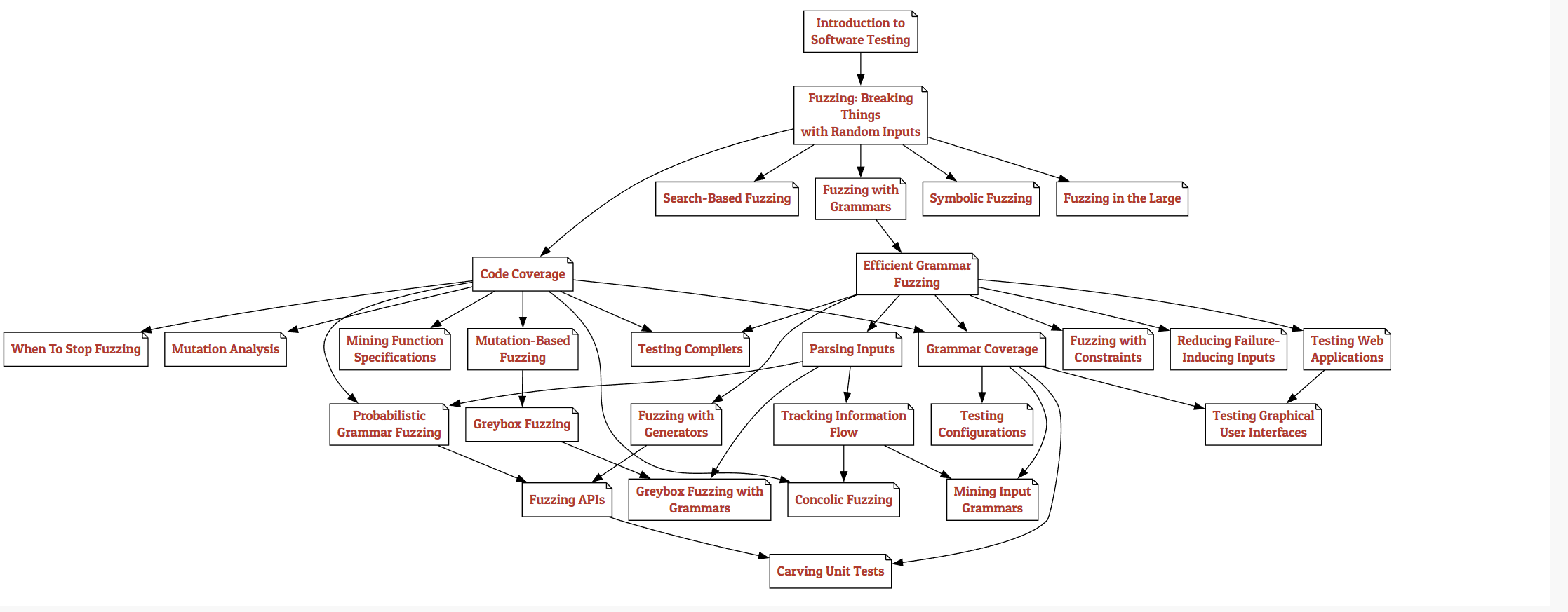
While the chapters of this book can be read one after the other, there are many possible paths through the book. In this graph, an arrow A→B means that chapter A is a prerequisite for chapter B. You can pick arbitrary paths in this graph to get to the topics that interest you most:
虽然本书的章节可以依次阅读,但书中有很多可能的阅读路径。在这个图中,箭头 A→B 表示章节 A 是章节 B 的先决条件。你可以在这个图中选择任意路径,以到达你最感兴趣的专题:

在这里留下你的足迹...